by Stanley W. Zamonski (Golden Aspen Herald Autumn at Bear Lake, Near Colo. 262, Beneath Towering Longs Peak In Rocky Mountain National Park, 1963) (Cashier’s Office) and Bob Petley (Autumn in the Valley (B1386), 1970) (Susie’s Office)
MAIN PAGE ⎔ SECTION PAGE ⎔ SITE MAP ⎔ GLOSSARY
ART OF THE LOBBY
COLORADO POSTERS ⎔ GERMAN POLITICAL CARTOONS ⎔ LOG HUT ON THE ST. MAURICE ⎔ MT. HOOD POSTCARDS ⎔ MYSTERIES ⎔ NORTHERN RIVER ⎔ PAYSAGE D’HIVER ⎔ SOLEMN LAND ⎔ STORMY WEATHER ⎔ TOWER OF BABEL
APPEARANCE
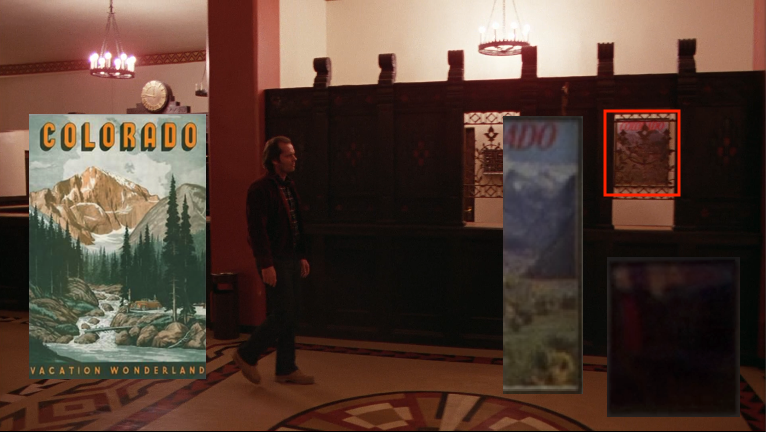
There’s three of these.
Golden Aspen Herald Autumn at Bear Lake, Near Colo. 262, Beneath Towering Longs Peak In Rocky Mountain National Park, 1963 – Stan Zamonski
This one’s tucked away on the short wall behind the cashier’s office. It’s seen first during the approach of Ullman and Watson in the lobby (19:41-19:46) and again when Wendy can’t get the radio to work (47:35-47:36), and again for a split second before Hallorann takes the axe (128:37) (the darkest one, bottom right). It seems to appear when Jack’s throwing the tennis ball at 39:24, though it’s hard to be sure.
UNKNOWN – Mt. YPsilON?
So the plainly visible one appears first as Ullman and Watson approach Jack for the tour (19:45-19:46, 19:49, 19:52-19:55 – stuff keeps getting in the way), then when Jack’s playing with the tennis ball (39:19-39:20), then really obscurely with the other one when Wendy can’t make the radio work (47:35-47:36) then as Jack’s going to murder the radio (94:09-94:11) (red box), then during Hallorann’s death march (128:00-128:16). This one flashes by again for a second as Jack stalks to get Danny (129:01)
Autumn in the Valley, 1970 – Bob Petley
And finally on the north wall of Susie’s office, half obscured by the door, as Jack gets in the killing mood (94:23-94:25). Actually, Susie’s one is seen for a sliver at 3:34 too.
IDENTITY
Stanley Zamonski was the curator of the Buffalo Bill Cody Museum, and a Coloradan historian who had published a couple books by the time of filming. Including The 59’ers – Roaring Denver, concerning the gold rush in 1859.
Bob Petley was known as The King of Postcards and The Cowboy Cartoonist. He specialized in landscapes and cartoons, some featuring a knock-off Bugs Bunny figure. Apparently roadrunners were another popular subject of his. I also appreciated the detail that he was the first to use Kodak Kodachrome (mentioned in Lolita) and the first to use rounded edges in his postcards.
SIGNIFICANCE
So far, I’ve gotten these from looking into images that appear on the cover of roadmaps, travel guides and postcards. In the novel, one of the first things we learn about Dan Torrance is his interest in roadmaps, which Jack leaves him to peruse and entertain himself with in the car when he goes into a pharmacy to make the thank you call to Al Shockley.
Autumn in the Valley
From what I can tell on Google Maps street view, this photo is taken somewhere between the outskirts of Ouray and Portland, Colorado (which dates back to 1902). Very likely that it’s closer to Portland, and shot with a zoom lens. The elevation of the shot suggests that it was taken from a tendril of either Wildhorse Peak to the east or Whitehouse Mountain to the west. Going by the lean of the shot, I’d put my money on Wildhorse. Probably right near the Bachelor Syracuse Mine Tour (an abandoned gold mine). Though it’s intriguing, since Ullman is noted to remind of JFK, that if it were a rise from Whitehouse, it would be a stone’s throw from the Dallas Trailhead.
Several professional photographers have taken almost this exact same shot over the years, with most noting Abrams Mountain in the middle distance, looming over Ouray and the Uncompahgre River (from a Ute word meaning red water spring). It’s possible we can see parts of Hayden and Engineer Mountains, but I’m less certain of these. Highway 550 is the only road in or out of the town, and becomes known as the Million Dollar Highway right as it curves around Abrams. In fact, when Dick is driving to the rescue and hears Hal and Charlie say on the radio that “many of the mountain passes, Wolf Creek and Red Mountain passes are already closed”, he’s hearing about a pass a couple clicks from where the Million Dollar Highway begins. The piece in which I first ID’d it noted these mountains as being part of the San Juan Mountains, Wolf Creek pass and Red Mountain pass marking the east and west ends of this chain, respectively. It’s also true that San Juan is Spanish for St. John, which is the name of the river in the painting that marks the entrance to room 237. So there may be an insinuation here that what happens in Ullman’s office is like what happens in 237. Since Dick is murdered right outside the office, this would go well with my notion that Dick is absorbed by the hotel into room 238.
Also, Ouray means arrow, and Apollo (from the sweater Dan wears into 237) was the god of archery.
When Wendy is watching the news, she hears a story about a “missing Aspen woman” named “Susan Robertson” lost in “the mountains near Ouray”. It happens that I made this ID right after getting the Aspen poster in the games room, that hangs behind Dan’s head in the first shot of him inside the Overlook, throwing darts. Susie is the one who brings Dan back in to the Gold Room after fleeing outside the hotel from this encounter with the twins in the games room.
I have a notion that Susan Robertson is a reference to Marguerite Roberts, the blacklisted screenwriter who penned the John Wayne classic True Grit, which was filmed in the mountains around Ouray. Kubrick may’ve had True Grit on his mind for a few reasons, but the protagonist being a teenager tracking her father’s killer goes well with Kubrick’s interest in Hamlet, and Danny potentially trapping Jack as a kind of revenge against the Jack of today, for the loss of former Jack. There’s also a villain named Tom Chaney, while King’s novel has a Lon Chaney subtext. The one helping her is Rooster Cogburn, while Dick has a rooster sculpture in his home.
Susie goes missing in the sense that almost everyone goes missing from the lives of the Torrances. But her main two functions in the story are bringing Jack his coffee in the interview, and bringing him back Danny in the games room. In my Snow White analysis, I see her as corresponding to the dwarf Happy (since she’s always smiling warmly), and the name Susan/Susie means lotus, so her absence from the story could speak to a certain lost happiness or lost serenity. I especially think this thanks to a little elephant figurine sitting below The Great Earth Mother, which hangs in her office. Ganesha was the child of Hinduism’s great mother figure, Uma, which is something that occurred to me while comparing how these items appear during the Abbey Road crossover study – the Beatles were considerably influenced by Hinduism. My reasons are complex, and have to do with a large analysis I haven’t made public yet. Bear with me.
It may also be worth noting that of the real ski resorts I’ve yet to ID among the game room posters – Steamboat Springs, Monarch Pass, Arapahoe Basin, Aspen, Copper Mountain, Broadmoor, and Crested Butte – Copper Mountain is currently a 3 hour 37 minute drive from Boulder. Jack tells Ullman he was able to make it up in “3 and a half hours”, which Ullman describes as “very good time” with Susie at his side. It’s possible highway speeds and connections have changed since then, but assuming everything is now as then, more or less, Aspen would be the best of the in-universe ski resorts to match the Overlook by radius from Boulder. That said, I’ve only ID’d about half of the posters in the room, so this could change.
The real missing figure in the story is Danny, after his experience in 237 causes Tony to take over control. There also happen to be aspen trees in a painting called Touch of Autumn, seen in the Suite 3 sitting room. I’ve lately been taking more seriously the name Kubrick gave Mrs. Massey, as evidenced by her death notice from a deleted scene: Mary Fallico. The evidence suggests that the story takes place from September 22nd to December 13th, entirely within the season of fall, despite the wintry climes. So if “Touch of Autumn” can be understood as “Touch of Fall”, that makes a good description of why Danny goes missing, if “Fall” could be regarded as the first part of “Fallico” – although that word is also the Italian for phallic. And here we have Autumn in the Valley, peeking out where Jack chops down Dick.
Also, aspen comes from a word meaning quick shaking, as in the way their leaves move in the wind. Quickness is a concept with a few connotations in the film. As when Wendy passes a German game show called Dalli! Dalli!, which can translated as Quick! Quick! Or there’s the Roadrunner cartoon Stop! Look! And Hasten! and the F1 racing album in Boulder. And if you’ve seen Eye Scream, you’ll recall that there’s two times someone says “quick” in the film, when Ullman says “let’s take a quick look at your apartment” and when Wendy says “Run and hide! Quick!” near the end, while stuck in the window. Those moments happen to be 2 minutes apart when you fold the film into the mirrorform, at which point the exact midpoint of them is the 19:21 mark (the year of Jack’s eternal missing-ness). But also, the notion of lost quickness goes well with what all the Torrances are like during their Overlook time. Especially Wendy on the last couple days, letting Jack get to the snowcat and radio before she could escape with Tony/Danny.
It’s also neat that Ouray bills itself as the Switzerland of America, as does Glacier National Park. Though I don’t think I have another reason to think that was on Kubrick’s mind, aside from all the WWII subtext, and how Jack’s desire to be part of the everlasting peace that was supposed to follow from WWII is part of what leads him into the dark heart of facism.
There is the thing how the full “COLORADO” appears behind the cashier, while only “ADO” appears on Susie’s poster, when Jack clicks the light on. Meaning “COLOR” is blocked. Is “colour” what Jack’s murdering when he kills the radio and Hallorann? Is it that simple?
Bear Lake
One curiosity for me is that Zamonski, long before Kubrick’s production, had been working on a never-completed book about a famous sex worker named Silverheels who died of smallpox, who was active in the 1860s. And while I don’t think it would be extraordinary for Kubrick to have researched the life of an included artist, knowledge about a project in development for that artist would require intimate research. Why this stands out to me is that The Lone Ranger is a significant part of the subtext for Full Metal Jacket (the 1956 film is playing at the theatre where they buy the sex worker, and Joker once calls Cowboy “Lone Ranger”). Which helped me to notice that Wendy’s outfit on the A MONTH LATER day is a blue plaid top with blue jeans and a red kerchief – the Lone Ranger’s colours. This is really striking in the two deleted scenes from this day, and less striking in the released film, where she only wears it under a large red coat during the maze walk. Joe Turkel (Lloyd) appeared as a villain on that show, so it would make sense for Danny and/or Dick to represent Tonto, who was played by Jay Silverheels. To have a famous sex worker Silverheels invoked in conjunction with a Tonto reference and a photo of Bear Lake, could shine a light on the nature of the bear mask sex that Wendy sees right after this piece appears for the last time.
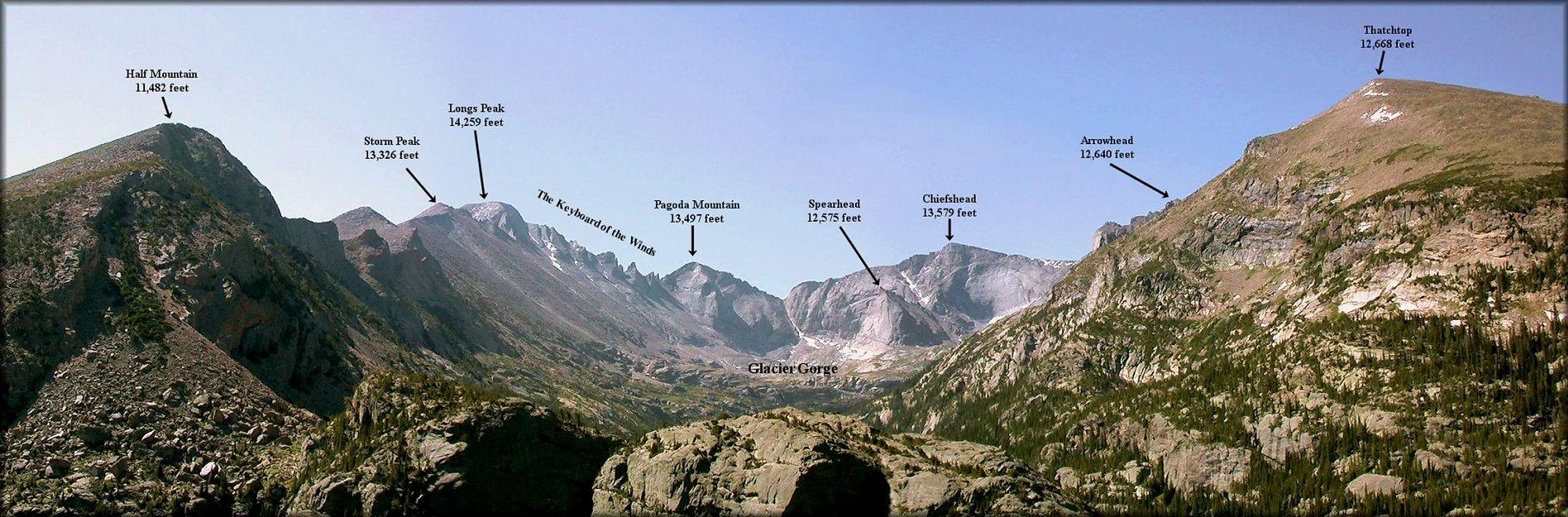
Thanks to a helpful annotator we know that this image contains Storm Peak, Longs Peak (of The Keyhole and Peacock Pool), The Keyboard of the Winds, Pagoda Mountain, Spearhead, Chiefshead, Thatchtop (Arapahoe: Buffalo’s Climb), and maybe Arrowhead, while Half Mountain and East Glacier Knob lay below them. Glacier Gorge is the valley below them all. And of course Bear Lake is in the foreground.
Longs appears on the Colorado State quarter, which means it might be beside Dick when he calls Durkin about the snowcat – several coins are visible on his briefcase. Along with Meeker Mountain, Longs is known as Twin Peaks, or The Two Ears (French), or The Two Guides (Arapahoe). Not to be confused with the Twin Sisters, another nearby set of mountains. But still. It’s apt that the paintings I call The Grady Twin Paintings would appear in conjunction with this twice.
Longs Peak was also part of Jules Verne’s From the Earth to the Moon, which goes broadly well with the film’s Apollo 11 theme, though I don’t have a better clue than this that Kubrick knew about that connection, and there’s a lot else going on here.
The Keyboard of the Winds is interesting since the East Wind album appears in Boulder and the West Wind car appears in Miami. The name refers to the way that winds create an eerie, ethereal sound from passing between the stones at the top of the ridge. Someone composed a piece inspired by the sound. But I like how this implies a certain animation to the inanimate. Like how some places shine and some don’t.
I think the thing I find most intriguing is the bear aspect of Bear Lake. If the still-mysterious poster that’s also behind the cashier’s cubby should depict something with “bear” in the naming, this would make it part of a series of items with two bears featured in them. Either literal bears or figurative bears, as in the many pairs of Bearspaw children.
And these are together in the money room, while the one near Portland is closer to Ullman’s. So, it could contrast the notion of Lloyd being “always the best of them” (despite being a villain to the Lone Ranger) with what the bears signify, now associated to a Silverheels. I should note that there’s another Portland reference in the film, on the label of a box in the storeroom. It happens that these rooms are right on top of each other in the Tower of Fable sense.
Next art reference: Paysage d’hiver, Laval
MAIN PAGE ⎔ SECTION PAGE ⎔ SITE MAP ⎔ GLOSSARY
OTHER MAIN PAGES FOR SHINING ANALYSIS
THE MIRRORFORM ⎔ THE BEATLES ⎔ THE RUM AND THE RED
BACKGROUND ART ⎔ OVERLOOK PHOTOGRAPHS ⎔ GOLDEN SPIRALS
PHI GRIDS ⎔ PATTERNS ⎔ VIOLENCE AND INDIGENA ⎔ ABSURDITIES
THE STORY ROOM ⎔ ANIMAL SYMBOLS ⎔ THE ANNOTATED SHINING
 EYE SCREAM