
by Bill C. Brown
MAIN PAGE ⎔ SECTION PAGE ⎔ SITE MAP ⎔ GLOSSARY
ART OF THE GAMES ROOM
1976 OLYMPICS ⎔ COWBOY ⎔ DENVER FLOOD ⎔ JACKSON HOLE ⎔ MYSTERIES ⎔ NATIONAL WESTERN STOCK SHOW ⎔ SKI BROADMOOR ⎔ STEAMBOAT SKI POSTER ⎔ STEAMBOAT SPRINGS ⎔ VAIL LAST RUN
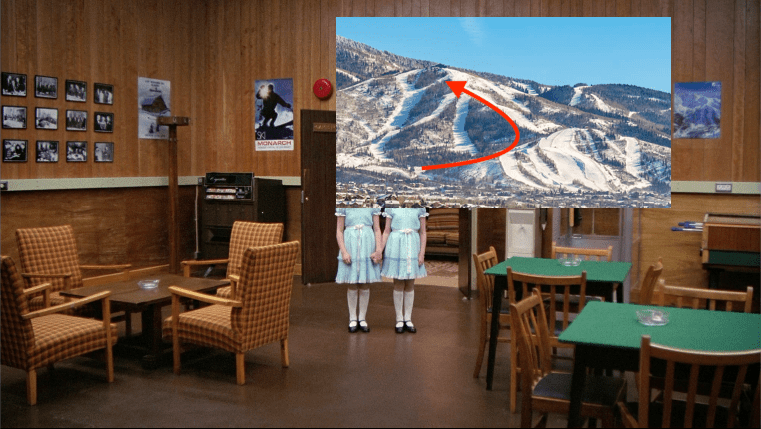
APPEARANCE
Seen behind the twins in the games room, in two shots, across 23 seconds (21:47-21:53 + 21:57-22:10).
IDENTITY
I used to think this was another Steamboat Springs, a twin for the one on the other side of the room. Clearly not the case. I’ll update the above photo in time.
I got this after IDing another Bill C. Brown poster, just up the wall from this one, of some Aspen ski slopes. I’ll let you head there for thoughts about the artist.
I will say that the sources I could find featuring this piece have its publication as 1982, which can’t be completely true. But perhaps it was close to the time of production: 1978-1979.
SYMBOLIC SIGNIFICANCE
In the novel, the Torrances live on Arapahoe Street in Boulder, which gets a mention in chapters two, four and seven. The name is a European exonym for several bands of indigenous people of the Colorado area. It’s believed to come from the Pawnee word for trader. The resort was founded in 1945 by Larry Jump and Max Dercum. It may be coincidence, but that reminds me of Larry Durkin, Dick’s trader friend who provides the life-taking/life-saving snowcat. Dick rides a 10-10 plane to get there, which may be referenced in the MONARCH poster across the way here. The National Western Stock Show posters also links to the concept of blackface, which would remind of the roles Dick and Durkin play in the film. And the Steamboat Springs poster of Steamboat Willie (Mickey Mouse), who will appear on Danny, and who bears a certain resemblance to black minstrel motifs. That would just leave Remington’s Cowboy, which reminds of how Danny will defeat a certain minotaur in order to make his way back to that snowcat.
Also, the one look we get at the snowcat outside Durkin’s occurs through the mirrorform from Wendy’s face against a bar of white wall with two heavy curtains to both sides, reminding of the middle three bars of an Arapaho Flag.
Apparently Plains sign for the Northern Arapaho means mother people, while the Southern Arapaho are indicated by rubbing the side of the nose with an index finger. This is what Ullman does during his last scene with Dick and Danny, placing his finger to the side of his nose and rubbing, after Dick suggests ice cream, and the two teams diverge (28:38-28:41). This poster is appearing right at the start of his tour. Perhaps this suggests that Ullman is a southern gentleman at heart, and maybe it’s his way of marking the Floridian Dick as one. In the deleted ending we learn that Ullman has a home in LA where he invites Wendy and Danny to stay. So maybe they’re both southern gentlemen. The names they gave themselves include sagebrush people and red willow people, two concepts included in the Touch of Autumn painting in Suite 3 (which is Dick’s flat during the on season).
Multiple other tribes knew them as Cloud People, which is also what the Be’ena Za’a were known as – the people possibly behind the Rainbow Yei pictorial in front of Wendy, when the Arapaho flag is behind her.
It may be worth noting that the Arapaho are a culture that includes the concept of two spirited people. Particularly since the opposite scene of the film is Tony REDRUMing around Suite 3, where we’d last been able to see Farewell My Concubine on the bed stand.
Next art reference: The Works of Dorothy Oxborough
MAIN PAGE ⎔ SECTION PAGE ⎔ SITE MAP ⎔ GLOSSARY
OTHER MAIN PAGES FOR SHINING ANALYSIS
THE MIRRORFORM ⎔ THE BEATLES ⎔ THE RUM AND THE RED
BACKGROUND ART ⎔ OVERLOOK PHOTOGRAPHS ⎔ GOLDEN SPIRALS
PHI GRIDS ⎔ PATTERNS ⎔ VIOLENCE AND INDIGENA ⎔ ABSURDITIES
THE STORY ROOM ⎔ ANIMAL SYMBOLS ⎔ THE ANNOTATED SHINING
 EYE SCREAM
