
MAIN PAGE ⎔ SECTION PAGE ⎔ SITE MAP ⎔ GLOSSARY
RANDOM ART FROM THE FILM
ARPEGGIO ⎔ BOMBO ⎔ COMMONERS CROWN ⎔ BLACK MUSIC & JAZZ REVIEW ⎔ MYSTERIES OF THE BOILER ROOM ⎔ MYSTERIES OF THE OVERLOOK ⎔ MYSTERY KITCHEN ART ⎔ SUPERNATURAL DREAM ⎔ TWO NIAGARA FALLS POSTCARDS ⎔ TONY THE TIGER
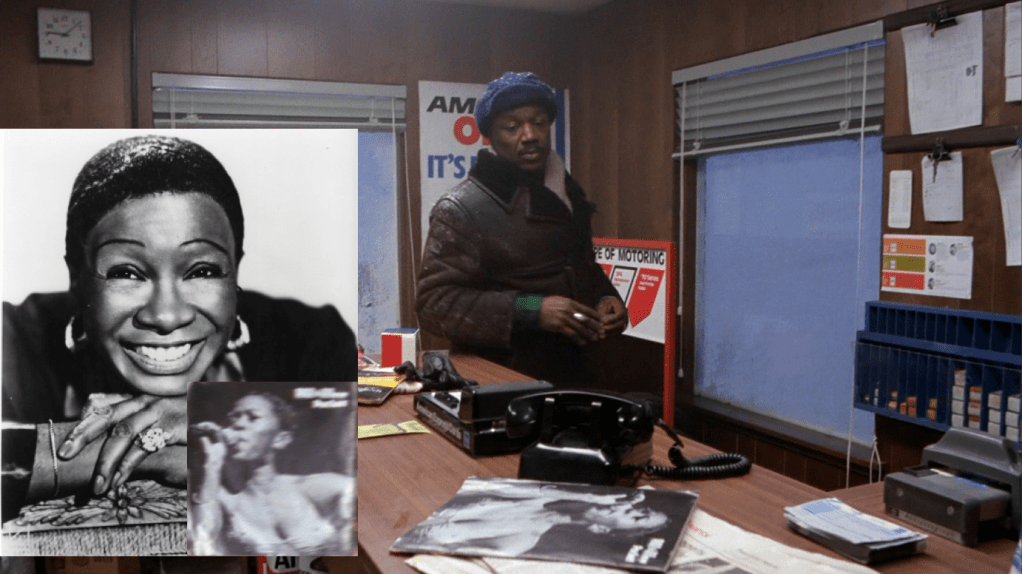
APPEARANCE
97:31-97:39
IDENTITY
I used to think the featured singer was Irene Reid (as will show in the site’s image until I upgrade my storage capacity), or possibly some obscure photo of Willene Barton singing, but she is in fact Jeanette Washington of the short-lived band Parlet (1978-1980). A spinoff group from George Clinton’s Parliament, it was comprised of three backup singers from Clinton’s funk empire: Washington, Mallia Franklin and Debbie Wright. And this is the back cover of the February 1979 copy of Black Music & Jazz Review, which was doing a spotlight on Clinton’s musical universe. I was extremely lucky to discover it on eBay, as I’d finally gotten what I thought was a good lead on the type of woman that would be in the image (a murder victim), only to get this image thanks to it looking like a different image of a different singer (who’d met a much worse fate).
SYMBOLIC SIGNIFICANCE
Durkin blocks our view of the magazine after the scene jumps to his other side. Since Wendy blocks One By One, and given that album’s severe significance to the film, I had doubted this would be anything less substantial. The group had one album out before filming began, 1978’s Pleasure Principle, which happens to be 5 seconds longer than One By One. So, three plays would bring us to 1:56:21, 32 seconds shy of the length of the “European” edition of The Shining, which happens to lose the Durkin scene. For what it’s worth, two plays would come to 1:17:34, and we jump from the shot of Dick driving to Durkin’s to Wendy crossing the lounge with her baseball bat at 1:17:43. So, although we lose Durkin, this album might be intended to remind us of his absence.
A second album came out during the later part of production: Invasion of the Booty Snatchers (June 1979). I doubt this would factor, but what would still be a crazy coincidence is that there was another Jeanette Washington, who also went by Baby or Justine, which apparently led to some confusion when this Jeanette Washington was emerging as a talent, singing backup for James Brown and George Clinton’s Parliament. I suspect this would be Kubrick’s main impetus for invoking Washington: underscoring the twin-like nature of things. The uncanny strangeness of two people emerging around the same time, undertaking the same profession. It reminds of the posters in Dick’s bedroom, one of Azizi Johari, and one people have speculated to be another Johari piece. This inspired me to have another search on that piece, but all I could find was this site claiming it’s a 1979 photo by German photographer Cheyco Leidmann. He did a piece called Foxy Lady in that year, which gained some celebrity. So Kubrick may be making another Jimi Hendrix reference (Hendrix is noted in A Clockwork Orange (his name is on the side of a piano, and he contributed to a couple albums seen in the record shop) and Full Metal Jacket (Eightball has a Hendrix pin on his helmet)). I’ve contacted Leidmann – hopefully we hear back soon.
I suspect that the newspaper below it, showing some kind of basketball game, will have a similar twin-like relationship with something else in the movie.
As for the name Parlet (originally Parlette, pronounced pahr-lett), Clinton’s brainchild was to make a female counterpart to some of his other projects, so I think it was meant to sound like Parliament (which most pronounce as pahr-lah-ment) minus the men sound. No men in parliament leaves parlet. We’re subtly thinking about a government run by women. While the cover of their Pleasure Principle album shows the three women as captains/pilots of a futuristic spaceship (which itself bears a certain design similarity with female reproduction organs). Mallia Franklin became known as the Queen of Funk, but I’m not sure if this was true at the time.
And Azizi Johari was in Rocky II, where Tony Burton (Larry Durkin) played Apollo Creed’s trainer, Tony “Duke” Evers. So I suspect there will be a certain daisy-chain effect when/if all the Shining‘s Afro artefacts are ID’d.
Clinton’s love of afrofuturism could be seen as a counterpart to Dan’s love of Star Trek. I haven’t made public my analysis on Dan’s phaser – you can read Juli Kearns’s thoughts on it here.
You may also be interested in this little YouTube video compiling some interviews with the band about their hardships involving one member’s drug problem and eventual departure, the way they were treated by venues, and the way Clinton distanced himself from the project shortly after its inception. According to them, the music was largely already produced and they were just brought in to sing on it, but they were then left to promote the work themselves, as if they were the principal artists.
It may be worth noting that Parlet is a proper name, linking eventually back to Peter, which means stone. Delbert Grady is played by Philip Stone. It’s also a French or German name relating to the concept of speech (French: parle – to speak), and so is thought to have been an occupational name for a lawyer or storyteller or even a ferryman, since parlet can relate to sailing (Durkin is how Dick gets up and the Torrances get back). Grady spills advocaat on Jack, a drink associated with lawyers (advocates) who would drink it to soothe their throats before going into court to make long speeches. I don’t think all this Grady energy is meant to suggest something sinister about Durkin, but notice that his colours are purple and green, the room 237 colours.
Also, the album was made for Casablanca Records, which was named for the 1942 film. There happens to be another Casablanca detail lurking in the Stanleyverse, but it’s part of what I haven’t published yet.
MIRRORFORM SIGNIFICANCE
During its eight brief seconds (97:31-97:39), Wendy kisses Jack at his typewriter and asks him if he got a lot written today. He replies with a stilted, “Yes.” The couple almost seem to be standing on the magazine when she kisses him. So, right as Jack’s transformation into the latest Charles Grady begins, we get a lot more twinning and Grady energy.
MAIN PAGE ⎔ SECTION PAGE ⎔ SITE MAP ⎔ GLOSSARY
OTHER MAIN PAGES FOR SHINING ANALYSIS
THE MIRRORFORM ⎔ THE BEATLES ⎔ THE RUM AND THE RED
BACKGROUND ART ⎔ OVERLOOK PHOTOGRAPHS ⎔ GOLDEN SPIRALS
PHI GRIDS ⎔ PATTERNS ⎔ VIOLENCE AND INDIGENA ⎔ ABSURDITIES
THE STORY ROOM ⎔ ANIMAL SYMBOLS ⎔ THE ANNOTATED SHINING
 EYE SCREAM