
by William Peter Blatty
MAIN PAGE ⎔ SECTION PAGE ⎔ SITE MAP ⎔ GLOSSARY
BOULDER LITERATURE – SKIP TO A PAGE
ANGELL, PEARL & LITTLE GOD ⎔ BEACH GIRLS ⎔ BOO ⎔ CAESAR ⎔ CHINA FLIGHT ⎔ CHRISTMAS BOOKS ⎔ DEATH DEALERS ⎔ DENVER POST ⎔ DR. NYET ⎔ EUROPE ⎔ FOURTH GHOST BOOK ⎔ GINGERBREAD MAN ⎔ GOLF LIKE THE GREATS ⎔ GOOD NEWS BIBLE ⎔ HOLDING ON ⎔ IN THIS HOUSE OF BREDE ⎔ KING OIL ⎔ MANIPULATOR ⎔ MY NAME IS ASHER LEV ⎔ NEW YORK REVIEW OF BOOKS (RED & BLUE) ⎔ NO END TO THE WAY ⎔ ORANGE WEDNESDAY ⎔ PEANUTS ⎔ SQUARESVILLE ⎔ TEENY WEENY ADVENTURES ⎔ TIGER OF THE SNOWS ⎔ TOWER ⎔ TRAPEZE ⎔ WISH CHILD ⎔ YOUNG JETHRO ⎔ UNIDENTIFIED
THE DOOR CONFUSION
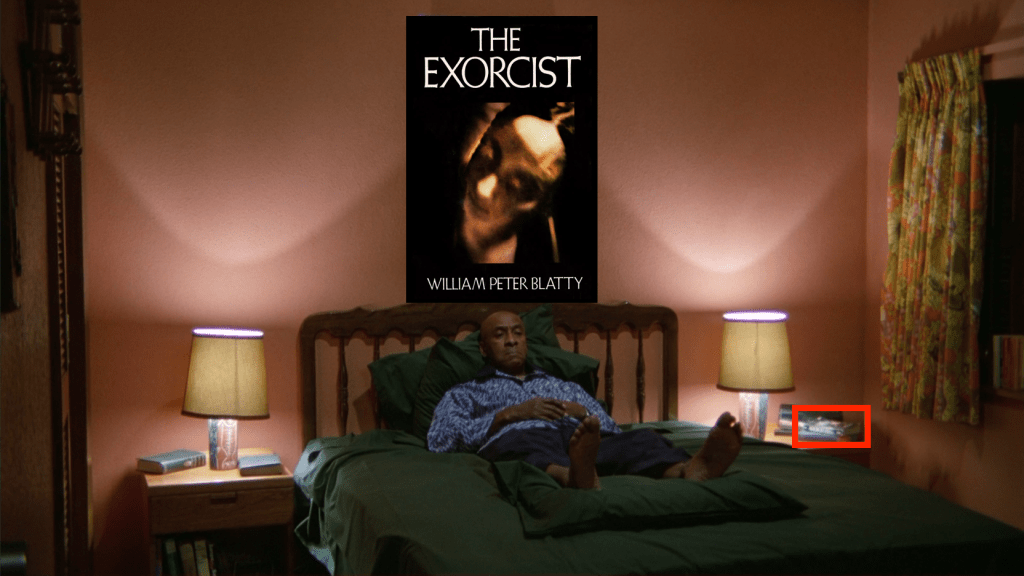
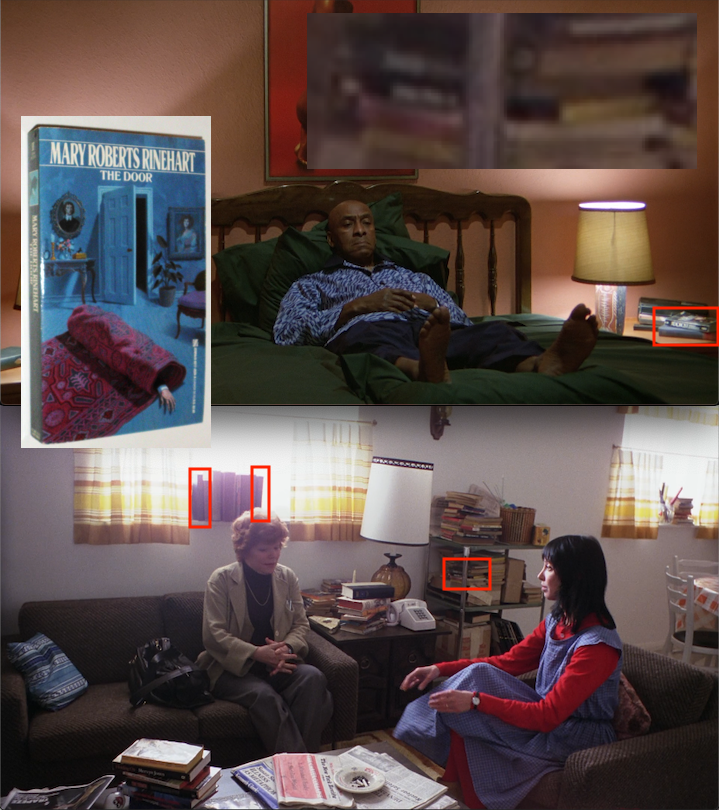
Corrrrection: it was recently brought to my attention by a fan of the site that the book in Hallorann’s room is in fact Blatty’s The Exorcist, and not Reinhart’s The Door. This may mean that only the one from the beginning is The Door, or that neither ever were. Hopefully you can see how easy this mistake was to make (it simply looks like the word DOOR is on the spine), and I suspect it’s one of only a few mistakes like this. That said, I know this is a component in several other analyses on the site, and I’m deep in my analysis of Eyes Wide Shut at the moment, and lack the time (or mental space) to consider everything this will change about this analysis and the others. For now, I will leave the old analysis below (where you’ll note that I was never “1000% sure” I had the right ID) so you can appreciate what this used to mean, and what it might still mean. I probably won’t ever remove the following analysis, but I will return some day to add my thoughts on this addition.
If nothing else, this stands as a testament to how easily we can allow an abundance of significances to lead us astray, and the importance of trying to be as exacting and accurate as we can be.
In fact, I’ve come to believe the book in Boulder isn’t The Door, but rather The Boo by Pat Conroy. There are in fact confirmed books that are shared between the Hallorann and Torrance libraries, and for a long time I thought this was one of them. So the fact that we would have two books that look like “DOOR”, one that does feature those two O shapes (BOO) and one that only looks like it does when out of focus (EXORCIST) suggests Kubrick was aware of the potential for confusion here, the potential for overlooking slight differences, as I seem to have done. Why create this confusion? What does it mean to have some books that are definitely the same, and one that only seems the same? And to have the seeming ones be easily mistaken for a third book?
APPEARANCE
70:43-70:52
IDENTITY
I’ve covered this, but William Peter Blatty, while best known for this work, was more prolific as a comedy writer, having penned the script for A Shot in the Dark, arguably the best-loved of Peter Sellers’s Pink Panther films.
SYMBOLIC SIGNIFICANCE
It almost seems silly to offer brief commentary on one of the more written-about films of all time, and certainly one of the most impactful and widely-admired horror films of all time… from within my own expansive analysis on one of the other most widely theorized horror films. But so too does it seem odd that Kubrick would include such a brief nod to a film he mentions immediately after saying Rosemary’s Baby was “one of the best of the [horror] genre”. I know we’ve got the complete Shakespeare in this thing, but Shakespeare is in the past, representing a much more ancient and established greatness. This is such a heavy nod to one of Kubrick’s biggest competitors in the run for greatest horror film of all time, and a competitor that was not long in the memory of anyone alive during production (which began 5 years after The Exorcist was in theatres). Both stories involve a child who seems to be possessed by a force of uncertain allegiance and intention, and both stories involve the noble sacrifice of an elder figure who goes through considerable doubt despite their apparent faith in supernatural forces. A sacrifice that successfully protects the endangered youth. So there’s also the way that the nod almost doesn’t need to be made – the similarities aren’t subtle.
So I wonder if one of the main things that allowed him to include it is Blatty’s connection to helping Peter Sellers gain an international audience via the Pink Panther series. Sellers is referenced directly across from this book, thanks to the appearance of the Steeleye Span album Commoners Crown, upon which Sellers does some vocal work and plays the ukulele. Perhaps if we can ever ID the other album in the room, or the “Europe” text that also appears in Boulder, we’ll see the forming of a ring of meaning encircling Dick.
As for the fact of two Sellers nods: this suggests a yet other dimension of meaning that could be read in various directions. Sellers was a talent Kubrick clearly admired, so we could read this as a sign of Dick’s quality. But there’s also the myriad characters Sellers represented in Lolita and Dr. Strangelove: the multi-faceted, mercury-minded Clare Quilty, and the three figures he created for Strangelove. Quilty functions as a kind of pedophilic shadow self for Humbert Humbert, while Strangelove functions as a megalomaniacal shadow self for the American president. Even within Strangelove is his alien hand syndrome, a kind of inner shadow self. So this could be our way of understanding Dick as a kind of shadow parent to Danny (he and Jack even read the same European history books). Though we may wish things could’ve been the other way around.
IDENTITY – THE DOOR
Just for the record, I’ve never been 1000% sure I’ve nailed this one. Given the nature of its role in the film, I think you’ll agree that there’s an extremely good reason to think it’s right, and the title could only really be a few different words (BOOK, DOOR, BOOR). So with that in mind, let’s continue.
Mary Roberts Reinhart was a prolific, prodigious author, known as the American Agatha Christie.
She described the experience of training to be a nurse at the Pittsburgh Homeopathic Hospital as “all the tragedy of the world under one roof” (that reminded me of the Overlook as a symbol in this story).
In 1947, after much personal tragedy, her chef of 25 years fired a gun at her and tried slashing her to death with a knife; he killed himself in his cell the next day (in Kubrick’s original treatment, Hallorann, the chef, tries to kill Wendy and Danny after arriving at the hotel).
She went public after a radical mastectomy in 1947, publishing an article “I Had Cancer” in Ladies’ Home Journal to help bring the discussion of cancer into the polite society, which it succeeded in doing; she encouraged women to have breast examinations (this would seem to speak to the Susan Sontag book review on the coffee table, about a similar subject).
She’s credited as the inventor of the phrase “The butler did it!” and the style of mystery known as Had-I-But-Known, and I think it’s interesting that her first work, a play, is called The Double Life (1906). In fact, “The butler did it!” is derived from The Door (spoiler alerts for both The Door and The Shining). So, aside from all these thematic connections, Jack calls Grady Jeevesy, which makes him out to be a butler or valet, which is what he’s dressed and acting like. So, to have this book be the only discernable book (there’s two others that you could maaaaaybe get) in Hallorann’s room is kind of interesting. It implies that the idea of the butler doing it was on his mind, so maybe he was already jacked up (despite it being 43 days after leaving the family behind) to believe Danny’s shine, and to react immediately.
Also, the Had-I-But-Known style is where a first-person narrator foreshadows impending doom by telling the audience that the knowledge they’ve acquired has made them regret their mistake in getting involved. Hallorann’s deepest regret, if any, was experienced only in the split second between Jack’s scream and Jack’s axe punching through his chest. But Danny does get the flash about the twins, the blood, and 237. Hallorann says there’s nothing to be afraid of, and then warns him to stay out. The next we see of Hallorann he’s about to get the 237 shine, and he’ll experience Danny’s experience there. So Dick knew exactly what was wrong with the hotel, and can’t really act surprised about the Torrance’s nightmare. Even Jack’s axe to the chest was something he knew had played out there before. So his Had-I-But-Known would’ve lasted about a second.
Wendy’s Had-I-But-Known is equally difficult to justify. Tony issued a dire warning, Danny tells the doctor in front of her he was “talking to Tony” before his blackout, Jack probably told her the Grady story (to “absolutely fascinate” her), and her confession about Jack’s abuse of Danny (emerging from the tale of Tony’s genesis), which includes an upbeat detail about her leaving Jack, lets us know that she should’ve been leery of this prospect, to say the least. Novel Wendy is much wiser to her blunder, but that’s beside the point.
I’ve also written about this book in the section where I suggest it signals that the middle of the movie is like a second beginning.
Before I leave Roberts I just want to note how many of her titles speak to the style of The Shining: The Double Life, The Circular Staircase, Seven Days, Two Flights Up, The Door, The Double Alibi, The Album, The Doctor, The Wall, The Haunted Lady, The Yellow Room, A Light in the Window, and Episode of the Wandering Knife. She even wrote two travelogues about travelling through Glacier Park, which is where the opening 3 minutes of the film is filmed. One is titled, Through Glacier Park in 1915/Seeing America First with Howard Eaton (1915). I don’t know, there’s just something about that that gives me chills. Also, I like this quote from her, “When knowledge comes in at the door, fear and superstition fly out of the window.” If Jack is knowledge, Wendy is definitely fear, and Danny is definitely superstition.
Next literary reference: The Denver Post
MAIN PAGE ⎔ SECTION PAGE ⎔ SITE MAP ⎔ GLOSSARY
OTHER MAIN PAGES FOR SHINING ANALYSIS
THE MIRRORFORM ⎔ THE BEATLES ⎔ THE RUM AND THE RED
BACKGROUND ART ⎔ OVERLOOK PHOTOGRAPHS ⎔ GOLDEN SPIRALS
PHI GRIDS ⎔ PATTERNS ⎔ VIOLENCE AND INDIGENA ⎔ ABSURDITIES
THE STORY ROOM ⎔ ANIMAL SYMBOLS ⎔ THE ANNOTATED SHINING
 EYE SCREAM